Yoga Nidra
A systematic way of resting the body completely while awareness stays awake. Swami Satyananda Saraswati shaped it from Tantric practices into eight stages that anyone can follow lying down, in about thirty minutes.
Between waking and sleep
Yoga Nidra works in the threshold state you pass through every night on the way to sleep. The practice slows you down to that edge and holds you there, aware.
A simplified picture. The one brain-imaging study of Yoga Nidra found increased theta activity during the practice (see Evidence).
From Tantra to a modern practice
Swami Satyananda Saraswati (1923–2009), founder of the Bihar School of Yoga in Munger, developed Yoga Nidra in the 1960s and set it out in his book Yoga Nidra (1976). Each part of his method adapts an older practice.
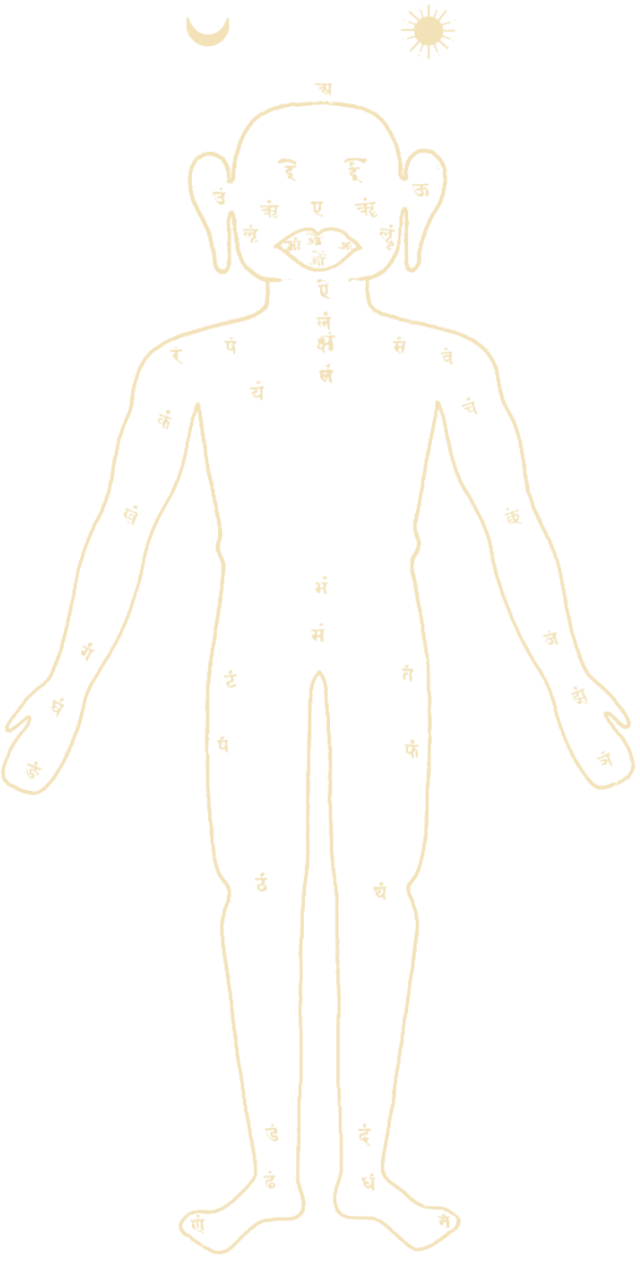
Bahir mātṛkā nyāsa
In Tantric worship, the fifty letters of the Sanskrit alphabet, the mātṛkā or "little mothers" of sound, are placed one by one on the outer body (bahir, outer), with awareness resting on each spot as its letter is sounded.
The vowels go to the head and face. The consonants follow the limbs in a fixed order, then the trunk:
| Body | Nyāsa: letters | Yoga Nidra: awareness |
|---|---|---|
| Right arm | कं खं गं घं ङं | Right hand and arm |
| Left arm | चं छं जं झं ञं | Left hand and arm |
| Right leg | टं ठं डं ढं णं | Right leg and foot |
| Left leg | तं थं दं धं नं | Left leg and foot |
| Sides, belly, back | पं फं बं भं मं | Back, then front |
Simplified for modern living. Yoga Nidra lets the letters, mantras and ritual fall away. What remains is the heart of nyāsa: awareness moving through the body in the same order, which anyone can follow lying down.
In Tantric ritual, mantras are "placed" on parts of the body, one after another, while awareness moves with them.
Satyananda kept the movement of awareness through the body and set aside the ritual. He related the order to the body's map in the brain's sensory-motor cortex.
The fifth limb of Patañjali's yoga: withdrawing the senses from their objects, so the mind turns inward.
Satyananda presented Yoga Nidra as a method of pratyāhāra: the senses relax one by one, and attention follows only the instructor's voice.
A resolve made at the start of a Tantric practice, stating its purpose.
A short, positive intention repeated at the beginning and end, when the mind is most receptive. This is the "manifestation" side of the practice.
In the Trika tradition: the Vijñāna Bhairava Tantra points to the junctions of experience, including the edge between waking and sleep, as doorways to awareness. Swami Lakshman Joo's teaching on dhāraṇā 32 (verse 55) connects breath, yoga nidra and chakrodaya. Explore Trika on 3ka.in.
The eight stages, as taught by Swami Satyananda
The practice descends gradually into relaxation, rests at its deepest point, then returns. Tap a stage to read it.
A 30-minute session
Typical proportions. Longer sessions mainly extend the rotation, breath and visualisation.
Rotation of consciousness
The simplified form of mātṛkā nyāsa: awareness moves through the body in a fixed order, naming each part and feeling it, without moving. Press play and let your attention follow the light.
Front view; the figure's right side is on your left. Back points show with a dashed ring.
How to follow: lie in śavāsana. As each part is named, say it mentally, feel it, and move on. No need to relax it on purpose; awareness alone is enough. If you fall behind, simply rejoin at the current point.
Counting the breath backwards
Breathe naturally and count each breath from 27 down to 1: "I am breathing in, 27. I am breathing out, 27. I am breathing in, 26…" If you lose count, start again at 27.
Counting backwards keeps the mind awake just enough to stay on the edge of sleep. Your own breath leads; this circle is only a guide, so pick the pace closest to it.
Opposite feelings, then images
Evoking a sensation and then its opposite trains awareness to hold both; in Satyananda's account it also releases stored emotional tension. Then come quick images in chidākāśa, the dark space you see in front of closed eyes.
Classic images for visualisation
The instructor names images rapidly; you see each one for a moment and let it go.
Your sankalpa
A short resolve, stated at the beginning and again at the end, when the mind is most open. Satyananda described it as a seed: planted in deep relaxation, it grows over weeks of practice.
Guidelines
Short and clear, one sentence. Positive: state what you want, not what you want to avoid. Present tense, as if already true. Keep the same one until it is fulfilled, rather than changing it each session.
Repeat it three times, mentally, with feeling. Results come gradually and in their own way; sankalpa is cultivation, not a quick fix.
Shape your sankalpa
Type it here to check it against the guidelines. It stays on this screen only.
- ✓Short: 12 words or fewer
- ✓Positive: no "not", "don't", "never" or "no"
- ✓Present tense: no "will", "want to" or "going to"
- ✓Personal: begins with "I" or "My"
What research shows
Yoga Nidra is one of the better-studied relaxation practices, though much of the research is small or uncontrolled.
studies, 5,201 participants. A 2025 meta-analysis found benefits for stress and anxiety, and smaller benefits for depression.
The authors caution that effects are likely inflated by low study quality, and call Yoga Nidra promising but not yet established as a clinical treatment.
dopamine release during Yoga Nidra in a 2002 PET brain-imaging study, alongside increased theta activity.
A single small study; striking, but it needs replicating.
Better sleep and lower stress are the most consistent everyday reports, which fits a practice built on deep relaxation.
Benefits build with regular practice, daily or several times a week.
Practising well
Lie on your back on a mat, with a light cover; the body cools as it relaxes. Use a recording or a teacher's voice, especially at first. Practise before meals or two hours after. Falling asleep at first is normal; the aim, over time, is to stay aware throughout.
Take care
- Never listen while driving or operating anything.
- If you live with trauma, PTSD, psychosis or severe depression, practise with a qualified teacher or your therapist's agreement; deep relaxation and imagery can bring up difficult material.
- If anything feels overwhelming, open your eyes, move gently and stop for the day.
Sources
- Swami Satyananda Saraswati, Yoga Nidra, Bihar School of Yoga, Munger (first published 1976).
- Swami Lakshman Joo, Vijñāna Bhairava: The Manual for Self-Realization; Jaideva Singh, Vijñānabhairava, Motilal Banarsidass, 1979.
- Kjaer TW, Bertelsen C, Piccini P, Brooks D. Increased dopamine tone during meditation-induced change of consciousness. Cognitive Brain Research, 2002;13(2):255–259.
- Ghai S, Odyniec P, Ghai I. Effects of Yoga Nidra on Stress, Anxiety, and Depression: A Systematic Review and Meta-Analysis. Annals of the New York Academy of Sciences, 2025;1556(1):e70149.